


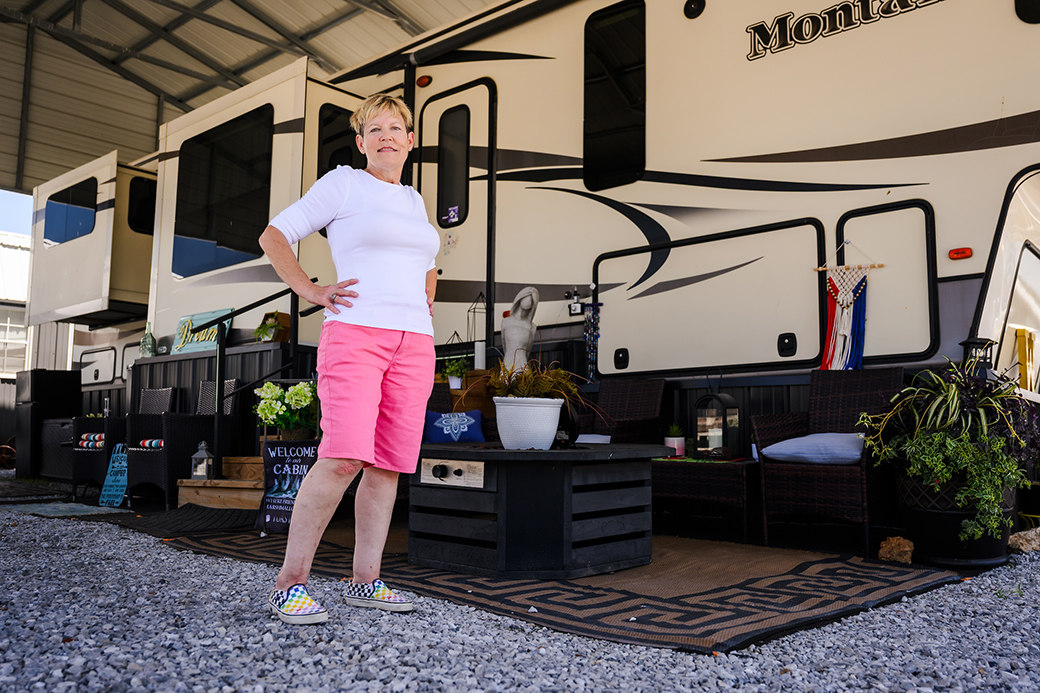
Living independently is important to Gail Ward.
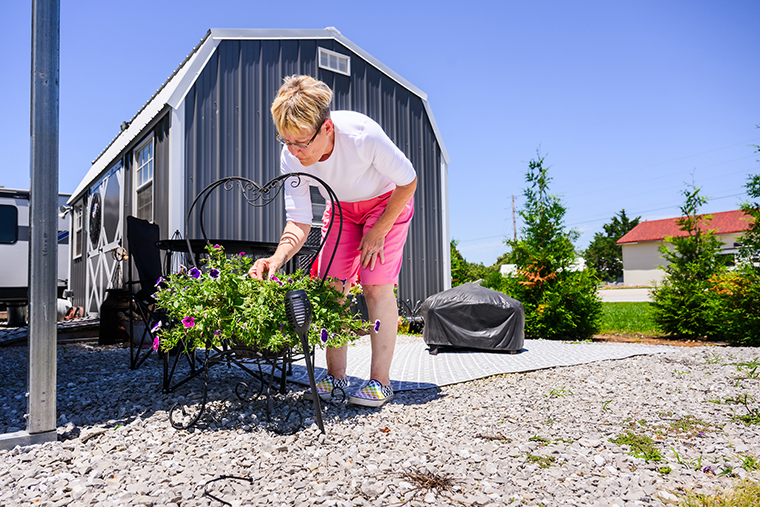
After retiring from the Army Dental Corps, she moved to Warsaw, Missouri, where she could be close to her parents as they got older. There, she built the life she wanted: All the time she wanted to spend with her rescue cats, Lucky and Precious, gardening, feeding birds and exercising in a low-stress environment.
“As long as my parents are around, I want to be around to assist them in any way that I can,” Gail said. “I enjoy living here because it gives you a life of simplicity, the people and community are great.”
Gail’s garden, and the rose tattoo on her left arm, are two ways she feels close to her mom, who loved all flowers, but roses especially.
“My mom always had so many flowers around her house,” Gail said. “I’m praying over my flowers, because I can’t grow anything, but it makes me happy to share that experience with her.”
But something unexpected turned Gail’s happy and peaceful life upside down in March of 2025. A car crash caused a serious injury to her right ankle and threatened to take away her ability to take care of herself.
She has no memory of what happened and woke up at MU Health Care’s University Hospital in Columbia hours after the crash.
There, doctors told Gail her life was not in danger, but she had suffered a severe traumatic injury to her right foot and ankle.
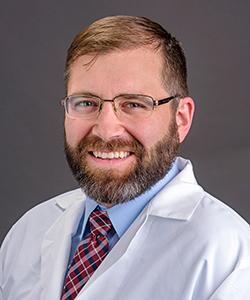
“Gail came in with a very particular type of fracture, called a pilon fracture, which is a much more severe ankle fracture,” said Kyle Schweser, MD, a trauma and foot and ankle orthopaedic surgeon at MU Health Care’s Missouri Orthopaedic Institute. “Most ankle fractures are rotational, but a pilon fracture is a crush injury that occurs when the bottom of your foot, your talus and heel bone, are driven up into the top of your ankle. That causes a lot of cartilage damage.”
A helicopter brought Gail to the ER where doctors, nurses and medical staff stabilized her. They placed a metal device, called an external fixator, around her right ankle to hold it in the correct position while she healed and the swelling went down.
As a Level I trauma center, the highest designation available, MU Health Care has around-the-clock staffing of emergency teams to take care of people with serious injuries like Gail.
“I woke up to my family in my hospital room and I had already been in surgery,” Gail said. “I was a little bit disoriented because I didn't feel that I was impaired at the time, but clearly I had an accident that resulted in significant injuries.”
Gail’s ankle had been placed in an external fixator, which held her joint and bones in the right position while the soft tissue swelling went down. In that time, she met with Schweser to talk about all of the options she had to get back on her feet and back to life in Warsaw.
Pilon fractures can be repaired with surgery, but in the long term many people still feel pain, stiffness and discomfort in their ankle even after a successful procedure.
“I have seen a lot of ankle injuries and a lot of the long-term problems that can arise after surgeries to fix pilon fractures,” Schweser said. “I had one patient who received a total ankle replacement, and after, broke their ankle. We kept the total ankle in and the patient did great. That made us start to think about new ways to help people with pilon fractures.”
Schweser’s team at the Missouri Orthopaedic Institute is the first in the United States to publish documentation of fixing a pilon fracture and replacing the ankle joint with an artificial joint at the same time.
A total ankle replacement — removing the bone at the base of the shinbone (the tibia) and the top of the foot (the talus) — is a specialized surgery that Schweser is an expert in. But until recently, it has not been offered to people with a pilon fracture.
“The technique has been used in all the other major joints in the body,” Schweser said. “Older people commonly get shoulder, elbow, knee and hip replacement surgeries after a fracture. Gail was someone I thought would be a good candidate, and I believed she would do well.”
Schweser spoke with Gail about this new treatment option, and the risks and benefits that came with each ankle surgery.
Schweser told Gail that he had performed six other total ankle and pilon fracture repair surgeries. He informed her of the known long-term results with other treatments, as well as the good short-term, but unknown long-term results if she chose to replace and fix her ankle.
“When he recommended surgery for my ankle, he gave me options,” Gail said. “From the get-go, it was, ‘These are the options that you have and ultimately, it’s your decision.’ He was honest about the risks and how effective they were likely to be, and I felt he was someone that I could truly have faith in, someone looking out for my best interests.”
Gail told Schweser she wanted to live independently and walk without pain. Together, they decided to replace her ankle joint.
“Gail and I talked about what she might be able to expect with the different approaches to repair,” Schweser said. “We spent at least 30 minutes together talking about all of her options before she decided to proceed.”
Once Gail’s swelling had gone down, Schweser fixed the fracture and replaced her right ankle. While she recovered in the hospital, neighbors watched her flowers and her cats.
Within two weeks, Gail was in inpatient rehab at Rusk Rehabilitation Hospital. She progressed carefully, and with determination, through all the steps of rehabilitation, going from a wheelchair to assisted walking devices to walking by herself. Gail, Lucky and Precious lived with her brother for a few months — his home in Warsaw had a ground level without steps — that helped her fully recover before she returned to living on her own.
“I wanted to be independent and I wanted to be able to do things myself,” Gail said. “I knew that I wanted to be able to go up and down stairs, exercise and take care of myself, and Dr. Schweser and his entire team at MU Health Care were lifesavers.”
When she got home and climbed the steps for the first time after her injury, she knew she had made the right decision.
“It seems minor but being able to just walk in there and be independent means a lot,” Gail said. “I live by myself, so even though I have a great support system in my family and my doctors, I wanted to be independent. I'm telling you, a lot of times I don't even remember that I've had the surgery. That's such a blessing.”