


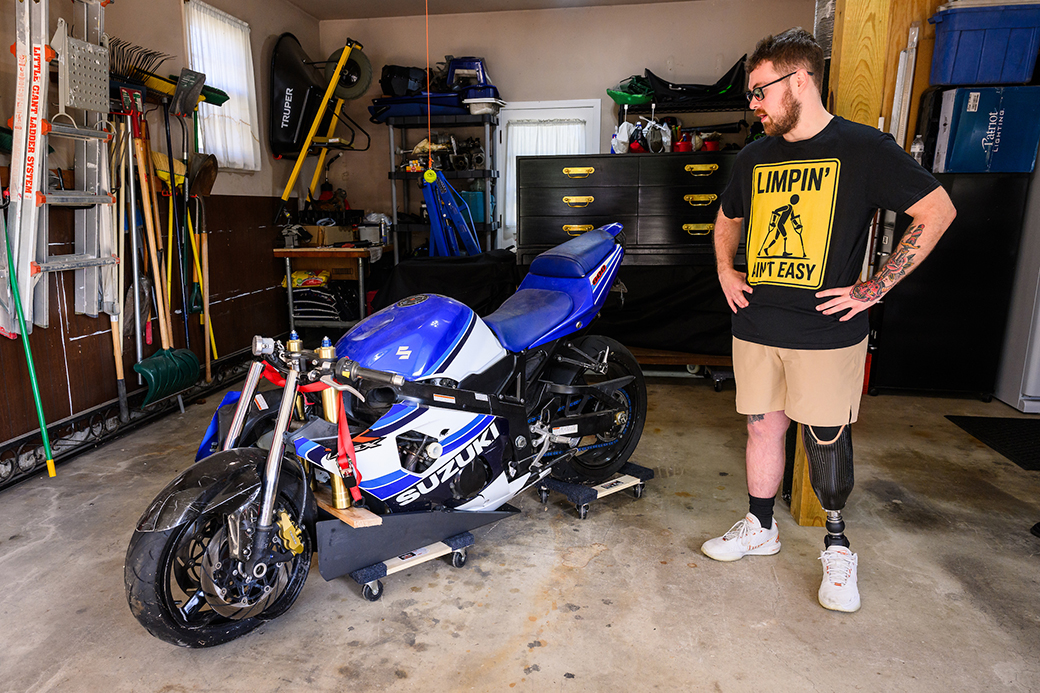
Tyler Ray was not born with a love for cars and speed. Unlike his older brother, Cody, he barely used his dirt bike when he was a kid.
When he discovered the joy of motorsports and speed, it was with a little help from his dad, Todd.
“My dad used to take me to the dragstrip a lot when I was a kid, and that was how he and I would hang out,” Tyler said. “I would always ask him to go faster and punch the gas pedal on the drive, and I think the majority of that transferred onto me, and it got me more into cars.”
“I’ve always been a little bit of a gearhead, and I was quite excited when Tyler followed me into the motorsports side of things,” Todd said. “One of those trips to the drag strip, I towed a friend’s car so he could run, and when I pulled up to the gate in my stock pickup, they asked if I was here to watch or run. I said, ‘What’s the difference?’ It was $20 to get in and $15 to run, so I said, ‘I guess I’m racing.’”
Tyler, now in his 20s, has fully embraced the joy of working on vehicles.
“I love my Honda S-2000 and my Chevy 1500,” Tyler said. “I like working on anything that has a motor, anything that makes cool noises, really. There’s a real sense of satisfaction that comes with knowing how to do things mechanically.”
When that love of vehicles got to motorcycles, Todd made sure his son knew what he was getting into. He asked Tyler to get his motorcycle license, take a basic safety course and buy a helmet before he came home with a motorcycle.
Tyler agreed, and put in the time to get his license and pass the safety course. Once he had his bike, Tyler quickly made friends as solo rides became day-long excursions.
Unfortunately, those rides came to an end for Tyler in the summer of 2025.
“When you ride, it just happens,” Tyler said. “Everybody goes down, it’s just a matter of when.”
‘I knew we were going to the hospital’
That summer, Todd was spending the weekends with his sister, taking care of their mom at her house. As he went to bed on Friday, August 1, he noted that Tyler wasn’t home yet. When he woke up in the middle of the night and saw Tyler still wasn’t back, he texted his son.
Where are you?
“Not 20 minutes later, the phone at my mom’s house started to ring,” Todd said. “My sister answered the phone, and I was already getting dressed. I knew we were going to the hospital. I knew what it meant because nobody knows that phone number.”
Todd and his wife, Cindy, went to Lake Regional Hospital in Osage Beach to see Tyler. They learned what had happened to their son, who was in a coma and on strong pain medication.
Tyler hit a gravel patch and lost control of his bike, then hit a guard rail, severing his left foot below the knee. As his friends rushed to help him while he was still on the ground, he was hit by another vehicle, which crushed his helmet, concussed him and broke bones in his face and skull.
“We got into the room, and they were preparing him for a helicopter flight,” Todd said. “He was missing his left foot, his face was swelled up the size of a softball, and it really hit you hard and fast just how serious this was.”
Thankfully, Tyler had friends with him, and local police and EMTs arrived quickly to apply a tourniquet and get him to the nearest emergency room. Tyler’s injuries were so extensive that doctors there decided to fly him to MU Health Care’s Frank L. Mitchell, Jr., MD, Trauma Center, mid-Missouri's only adult Level I trauma center.
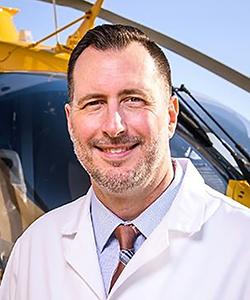
“Tyler had injuries from his head to his toe,” said Jeffrey Coughenour, MD, the trauma center’s medical director. “He had brain injury, facial fractures, thankfully no major issues in his chest or abdomen, and then quite a few extremity injuries to include the left lower leg amputation. He already had great stabilizing medical care when he arrived, so we focused on treating those complex injuries with our colleagues in orthopaedic surgery, neurosurgery and ear, nose and throat surgery.”
Todd and Cindy arrived in Columbia not long after the helicopter. They were confident Tyler would live, but weren’t sure what he would be like when he woke up.
‘Laughing helps you not cry about it’
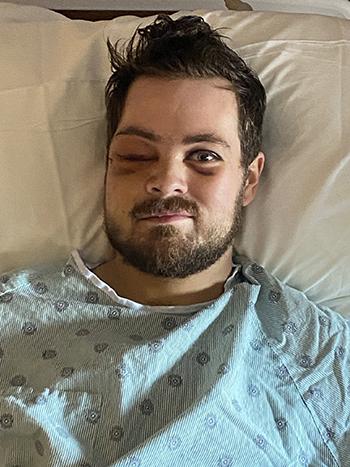
Early the next week, Tyler started getting visitors. His parents met his riding friends, quickly welcoming them into the family. His dad pointed out that Tyler’s face was still swollen because of the broken orbital bone above his right eye and joked that Tyler looked like Sloth from “The Goonies.”
“All of a sudden, he just says, ‘Hey, you guys!’” Todd said. “We all laughed, but I thought that was a great sign that he was going to be OK.”
“Those visits are what helped me to keep pushing, keep going, feel motivated,” Tyler said.
Tyler and Todd have always bonded with that kind of humor, and it helped the two of them process what had happened.
“I don’t remember anything from the day of the crash or after until I woke up in University Hospital,” Tyler said. “I remember trying to itch my left leg because I was having phantom sensations, and my dad told me I didn’t have a foot. He wrote on the whiteboard in my room that I’m 5-foot-10 on the right side and 4-foot-11 on the left side. That’s where I get my sense of humor from, and it helped a lot. Laughing helps you not cry about it.”

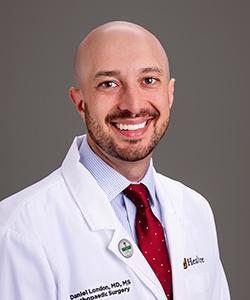
During his month-long hospital stay, Tyler met and was cared for by too many doctors, nurses and staff to remember. Two of the faces he does remember are orthopaedic surgeon Daniel London, MD — who performed an amputation recovery procedure called targeted muscle reinnervation, or TMR, that helps prevent phantom limb pain and sensation — and head and neck surgeon Keonho “Albert” Kong, MD, who surgically repaired Tyler’s skull with titanium plates and screws.
“Dr. London did my TMR and was always very supportive, checking on me and calling me every month or so, he was very helpful,” Tyler said. “When I had complications with my ear because of the bone fractures, Dr. Kong was always there and supportive, welcoming me in whenever I came in for an appointment.”
“He had seven teams of doctors, and they all communicated so well with everybody, they knew what everybody else was doing,” Todd said. “They worked together like an engine.”
Tyler stepped down from the surgical intensive care unit as he recovered from four separate surgeries.
“To have our plastic and orthopedic surgery colleagues, our rehab colleagues, to be able to offer some newer things in limb preservation or recovery following amputation, that is just that much more reassuring that we can achieve really good things for the most critically injured patients like Tyler,” Coughenour said. “Thankfully because he is young and otherwise healthy, he was able to begin to improve quickly.”
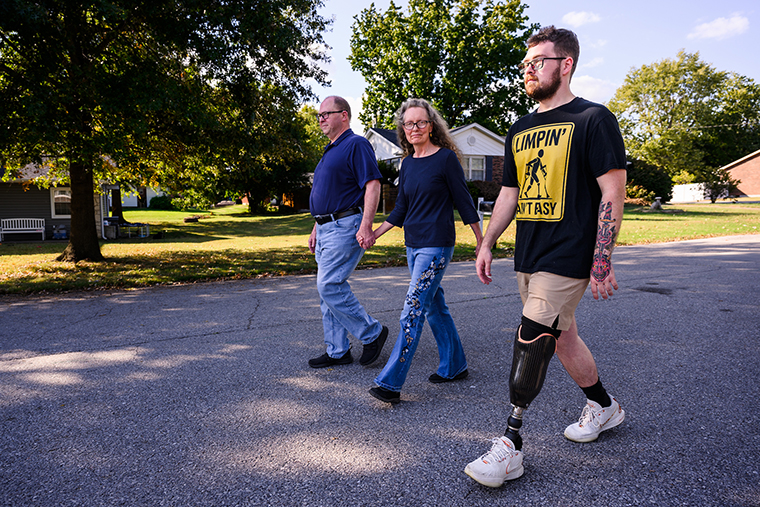
The first steps as TyBorg
Tyler was excited to start inpatient rehabilitation at Rusk Rehabilitation Hospital in Columbia, where he could start moving, working on rebuilding his strength and start the process of receiving a prosthetic.
“Tyler’s care was more of a marathon than a sprint, but we were confident that we could help his family and his support system get to the finish line,” Coughenour said. “Tyler is the example of trauma care, because our goal is to not only to save your life, but to get you back to doing what makes you happy. His case reminds me every day of why I’m here, which is to do our best to have outcomes like this.”
Tyler's sense of humor hasn’t wavered, from ordering custom tee shirts with jokes about being an amputee and doing wheelies in his wheelchair to earning new nicknames.
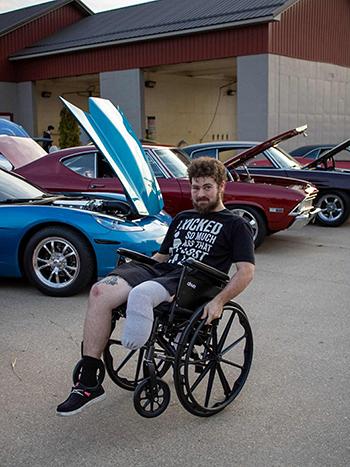
“With the titanium holding my head together and the prosthetic leg, it was like I was part cyborg, so my friends started calling me TyBorg,” Tyler said. “I think it fits.”
Tyler went through prosthetic fittings and learned how to take care of his new foot at Rusk, and received his first prosthetic in December of 2025, just in time for Christmas.
“After leaving Rusk that second time, I felt like life could go back to normal,” he said. “Once I got my prosthetic, it felt like I had that sense of freedom again, like riding a motorcycle. I felt motivated.”
Once he regained his independence, Tyler’s experience helped him realize he wanted to help other people. He started work in Jefferson City caring for and supporting people with physical and intellectual disabilities.
Tyler is still working toward goals of his own, including running and jumping so he can get back to playing pickup basketball. But he can shift a manual car transmission with his prosthetic left foot and is otherwise healthy and happy.
“I feel very thankful and grateful to be alive, to everyone from the first responders to all of the doctors and nurses who took care of me to my friends,” Tyler said. “The level of care is truly incredible, and they genuinely cared about me. I'm still warming up to a prosthetic leg, but my life is pretty, pretty close to back to normal.”