


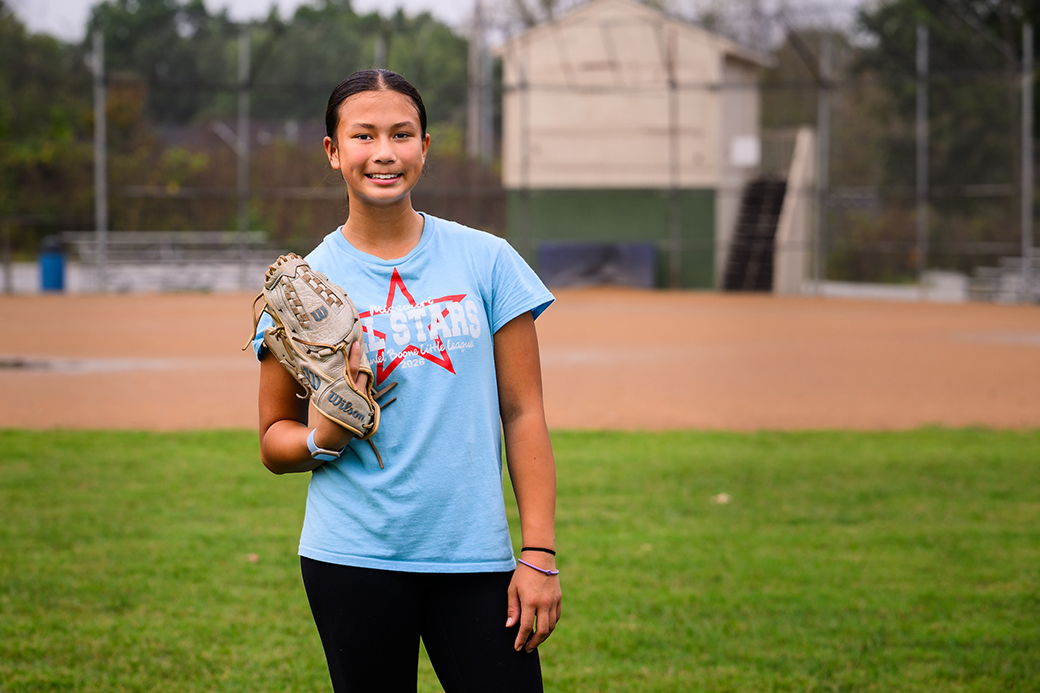
When Arielle Rhodes first started playing softball, she could only dream about where the sport might take her.
Even then, she might never have imagined she would play on television or in college.
“When Arielle first started when she was 3 or 4, it was something to keep her busy and active, and we saw that she really enjoyed it,” her mom, Marianne Lopez Rhodes said. “By age 8 or 9, you could tell she started to get more competitive about it.”
Arielle enjoyed practices and honing her skills in the cages. She loved the social side of softball, bonding with girls her age.
“I remember one game playing machine pitch when I was 9 or 10,” Arielle said, “And I realized that I loved softball because it felt good to win. And we hated to lose.”
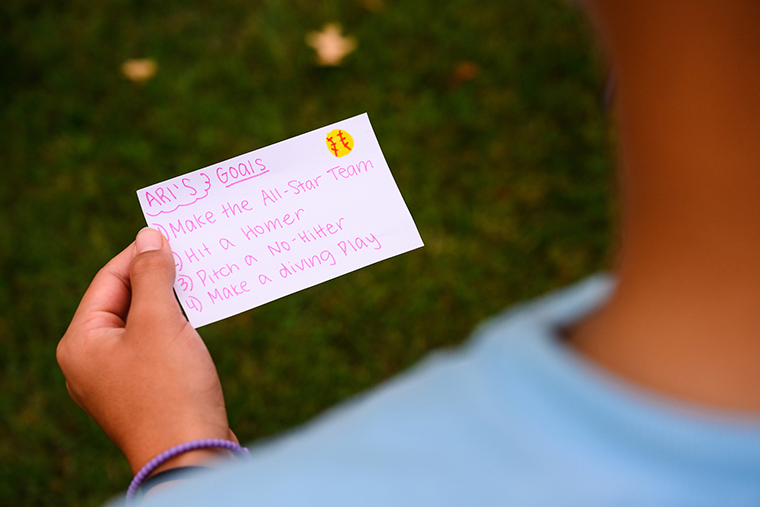
Arielle started making plans and writing out her goals on an index card: Hit a home run and make the 2026 Daniel Boone Little League All-Star team.
But at a tournament that fall, she started feeling back pain worse than anything she had felt before.
“I pitched a full game, we had a break, and I was warming up to pitch again when it started to hurt,” Arielle said. “It felt like I had a bruise and someone was constantly pushing on it.”
That pain changed her ability to play softball and put her goals on hold.
“At the tournament, she could not even run after she bunted or run after a ball that she would normally catch,” Marianne said. “That’s when I knew something was really wrong.”
The next day, Marianne brought her daughter to MU Health Care’s walk-in Sports Medicine Injury Clinic in Columbia. Sports medicine experts took X-rays of Arielle’s back, which were negative, and scheduled a follow-up MRI. The MRI showed a stress fracture on both sides of her L4 vertebra in her lower back, called a pars defect.

“These injuries can be missed very commonly, because the bones involved are so small that fractures don’t show up on X-ray, and they often are missed on MRI,” said Brady Fleshman, MD, a family medicine and sports medicine physician at MU Health Care and team physician for the Mizzou softball team. “Arielle’s X-rays were negative, but what stood out to me was her pain score went up with back extension exercises, which we know is a symptom of stress fractures in the low back.”
Fleshman’s diagnosis was that Arielle did not need surgery. But she would need to rest for several months, wear a back brace, and go through physical therapy before she was cleared to return to softball.
“I was really sad, because I love playing softball,” Arielle said. “I missed two tournaments at the end of the season, and I was worried I wouldn’t be back in time to play in a local league and then try out for the All-Star team.”
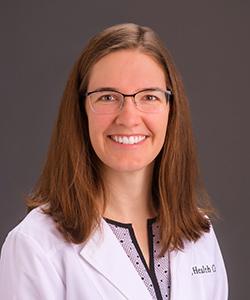
Fleshman also sent Arielle’s MRI results to Lauren Pringle, MD, a musculoskeletal imaging expert at the Missouri Orthopaedic Institute. Pringle is a clinician and researcher who focuses on improving diagnostic capabilities to catch more hard-to-spot injuries like Arielle’s.
“These injuries frustrated me, because MRIs weren’t as helpful in confidently making a diagnosis, and for young patients especially, we want to avoid radiation from CT scans,” Pringle said. “When we started this research project, I learned that there were some technological upgrades and more advanced MRI sequences that we could use, and now we can actually see these fractures that are one or two millimeters in size.”
In the past, MRI scans of the lumbar spine took “slices,” or cross-section images, every 4 or 5 millimeters. The pars interarticularis, a small, bony bridge that connects the upper and lower joints of a vertebral body, can be as small as 5 millimeters, which meant that an MRI could easily pass over an early fracture.
Arielle chose to enroll in the study, which took four series of high-resolution MRI scans — with slices every 1.29 millimeters — of her lumbar spine over 12 months. The initial images, in October of 2025, showed a clear fracture through bone on both sides. She had her second MRI scan in December, and the detail available to Pringle showed that the bone had already started to heal.
“Now, we can see a one-millimeter fracture, and I can see the percentage of new bone bridging across a fracture,” Pringle said. “In the past, I never would have been able to say anything with that level of detail from an MRI. But now we can see that healing process almost in real time because we can see that early bone formation.”
Pringle and Fleshman worked closely together, and by using her MRI results and pain score, Fleshman was able to confidently create a safe return-to-sport plan for Arielle.
“We were a little more cautious with Arielle, because she broke both sides and there was some separation, or displacement,” Fleshman said. “Working with Dr. Pringle and seeing that healing meant I was allowing Arielle to do more after each visit, and it gave us both the confidence that she was progressing without pain.”
The lack of pain was a big deal for Arielle.
“I was excited to have an answer, because this was something that would maybe mean I had back pain all of my life,” Arielle said. “But I have no pain left.”
And even with the extra precaution, Arielle started physical therapy at Mizzou Therapy Services in December of 2025 to work on rebuilding her back and core strength.
When she was cleared to return to softball in the spring of 2026, the normally stoic Arielle ran around the yard with excitement.
“To have access to that walk-in clinic was amazing,” Marianne said. “Time is of the essence, especially when you have a kid that's wanting to get back on the field as soon as possible. The kind of care Dr. Fleshman and his team provided, it was really tailored to her and what she wanted to do, and all the decisions involved her.”
Arielle played on a Daniel Boone Little League team and struck out a batter in her first outing back as a pitcher. She hit a home run not long after, and a few weeks later, made the All-Star team, checking off two of those goals.
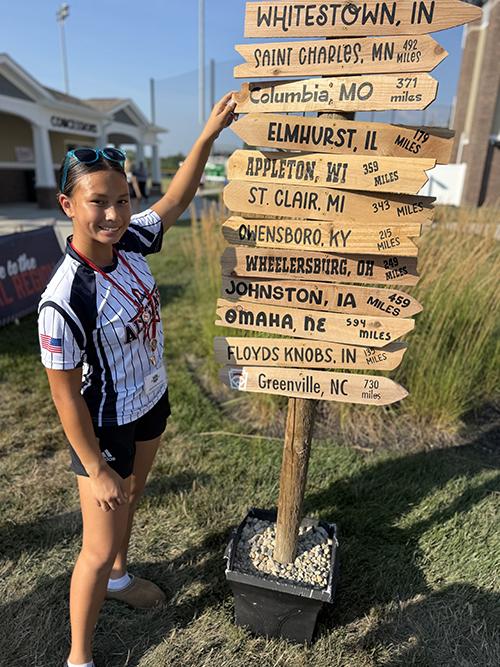
The squad won their district and state tournaments, and competed at the regional tournament in Indiana for the right to go to the Little League Softball World Series, where they played a game on ESPN, and Arielle met her softball hero, Monica Abbot.
“Making the team makes me feel really proud because I know I worked my butt off, and it took a lot of time and effort,” Arielle said. “I saw softball on TV growing up, but I didn’t think that I could be on TV.”
Arielle knows that the people in her life — her family, her teammates and her doctors and therapy team at MU Health Care — have her back. She is confidently continuing to set her sights higher to make her softball dreams come true.
“My goal is to make a Division I college team,” Arielle said. “Then you’re playing with the best of the best from around the country. That would be amazing."