When you’re pregnant, your care team may recommend a chorionic villus sampling (CVS), a prenatal test during your first trimester that can help identify genetic and chromosomal conditions in your baby.

A CVS can give you information about your baby’s health early on in your pregnancy. It can test for hundreds of conditions, including: 

  • Cystic fibrosis
  • Down’s syndrome
  • Fragile X syndrome
  • Sickle cell disease
  • Tay Sachs
  • Trisomy 18

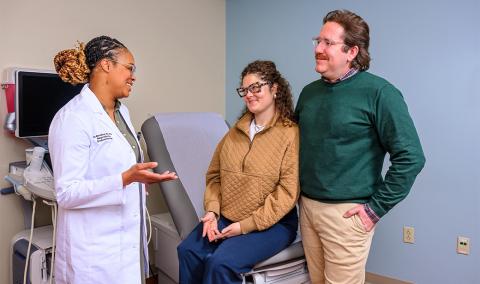
Your pregnancy care team can help you understand: 

  • Whether you’re a good candidate for CVS
  • What to expect during the test
  • What the results mean for you and your baby
  • Potential next steps depending on the results of the test

Am I a Candidate for CVS?

You can have a CVS during your first trimester, typically between weeks 10 to 13 of your pregnancy. A CVS is a more invasive test than other prenatal tests like ultrasounds and fetal monitoring. That’s why we typically only recommend CVS if: 

  • You are 35 or older
  • You or your partner has a family history of genetic conditions like cystic fibrosis, Down’s syndrome or Tay Sachs
  • You have another child who has a genetic or chromosomal condition
  • You had a prenatal ultrasound that identified potential risks
  • The results of another genetic screening test indicated potential risks

CVS Risks

While CVS is a common prenatal test that thousands of women get every year, there is slight chance of complications. The risks for CVS include: 

  • A one in 300 chance of miscarriage after the procedure
  • A small risk of infection inside the uterus after the procedure
  • In rare situations, CVS can cause some of your baby’s blood cells to mix with your blood cells. This can be harmful to your baby if you are Rh negative and your baby is Rh positive. Your care team will determine your and your baby’s blood type before the procedure.

Our team will discuss all risk factors with you before your CVS so you can decide whether this test is right for you.

How Accurate is a CVS?

CVS is about 99% accurate in identifying hundreds of congenital conditions. However, CVS does not reveal how serious your baby’s condition is or test for neural tube defects, such as spina bifida. To supplement the results of a CVS, your care team may recommend additional tests, such as: 

  • Amniocentesis
  • Diagnostic ultrasound
  • Fetal echocardiogram
  • Fetal MRI
  • Genetic testing and counseling

Benefits of CVS

A CVS is a highly accurate way to find out if your child has a genetic or chromosomal condition before they’re born. 

With a CVS, knowledge is power. The biggest benefit of having this test is knowing specific details about your baby’s health and development early on in pregnancy. If your CVS indicates that your baby has a certain condition, your care team can go over your options with you and help you plan your next steps.

What to Expect with CVS

Our team performs your CVS during your first trimester, between weeks 10 and 13 of pregnancy. 

During your CVS, your care team will: 

  • Check your vital signs, including your temperature, heart rate and blood pressure.
  • Perform an ultrasound to check your baby’s heart rate, as well as the location of your baby, the placenta and the umbilical cord.
  • Either insert a catheter into your cervix (Transcervical CVS) or insert a needle into your abdominal (Transabdominal CVS) to the placenta to get a tissue sample.

The CVS will feel like a Pap smear, with some minor discomfort, pressure and cramping. 

After the procedure, our team will send the tissue sample to a lab for review.

CVS Results

Our genetic specialists test the placenta tissue sample for genetic or chromosomal abnormalities. Your care team will contact you with your results. 

We are here to support you after a CVS, no matter the results. Your care team will be by your side, helping you understand the results and your options. 

Our team will discuss next steps with you, which may include: 

  • Referring you to a fetal care specialist who may offer treatment options for your baby before delivery.
  • Referring you to a maternal fetal medicine provider (e.g., an OB/GYN who specializes in high-risk pregnancy) to provide you and your baby with an extra layer of care.
  • Coordinating care with pediatric specialists who can care for your baby after delivery.
  • Providing social and emotional support services to help you and your family prepare for any necessary lifestyle changes.